One of the greatest political allegories of all time. It is a book for anyone and everyone, with its fading brilliance even after fifty years. ” – Ruth Rendell, Daily Telegraph
“His allegory remains our greatest satire of the dark face of modern history.” – Malcolm Bradbury, “Mail on Sunday”
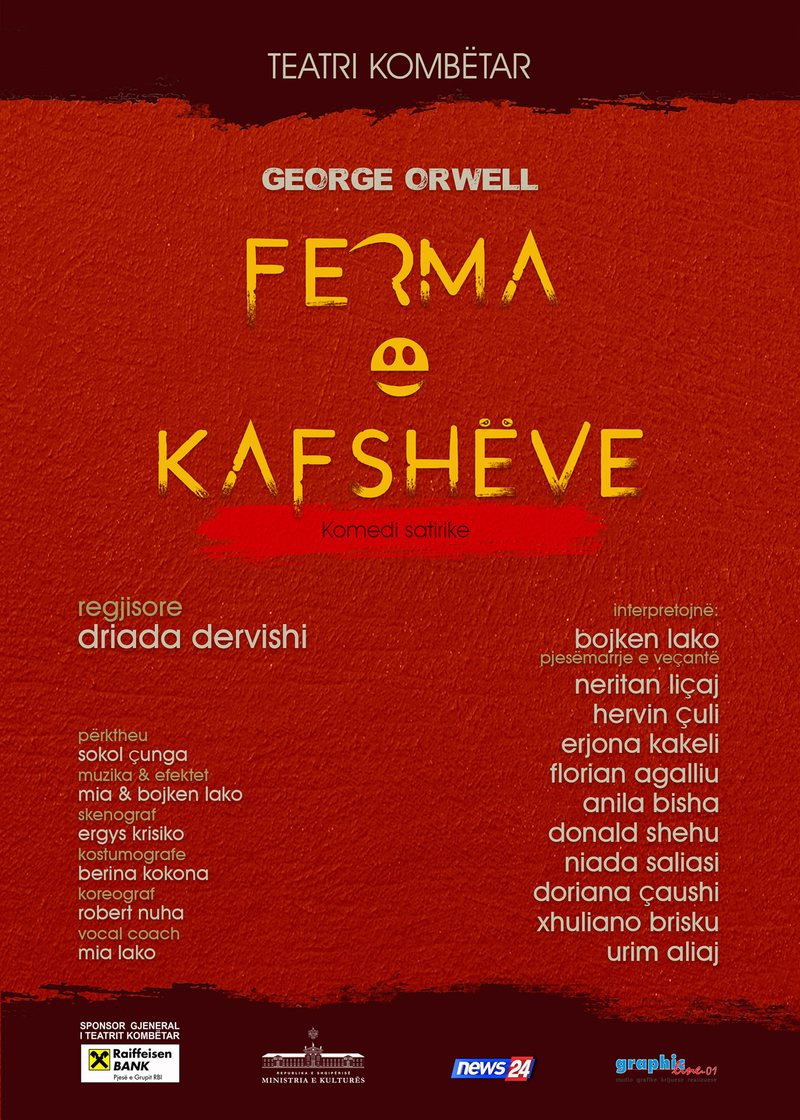
The actors return to the stage. The National Theater opens the artistic season – “Animal Farm”, Orwell’s masterpiece, which rises against any tyranny, brings back to the stage the actors of the National Theater, after the not short absence that conditioned the pandemic.
The work is directed by Driada Dervishi, absolute premiere on the dates: 10, 12, 13, 14 and 15 July, at 21:00 in the amphitheater of the artificial lake in Tirana.
In the roles are actors: Neritan Liçaj, Hervin Çuli, Erjona Kakeli, Florian Agalliu, Anila Bisha, Donald Shehu, Niada Saliasi, Dori Caushi, Giuliano Brisku and Urim Aliaj. The work is translated by Sokol Çunga, music and effects Bojken Lako and Mia Lako. Scenography by Ergys Krisiko, costume design by Berina Kokona, choreographer Robert Nuha, vocal coach Mia Lako.
One of the most famous political allegories of the twentieth century, “Animal Farm” takes us to the political world of the post-revolution, where the liberators become oppressors and the oppressed end up in the shredder of history.
Another extraordinary novel of political prophecy is the novel “1984” whose joke “Big brother is watching you” (Big Brother is watching you) has become a common use of everyday language.
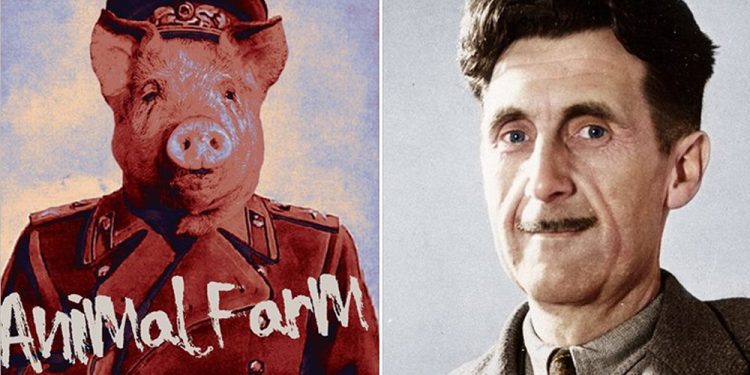
George Orwell was born in 1903 in Motihari, Bengal, India. His real name was Eric Arthur Blair. His father, Richard Walmesley Blair, served as a civilian for the British government. In 1904, Orwell moved with his mother and sister to England, where he remained until 1922. He began writing at a young age and even published in college periodicals, but did not like school.
Orwell wrote about his unpleasant experiences in prep school in the essay “Such were the Joys” (1968). He did not gain any right to study and as he could not afford to continue school, he went to Bruma and served in the administration of the Indian Imperial Police from 1922 until 1927, when he resigned, in part because of his growing incompatibility. for British imperialism, which he expressed in his essays “Shooting an Elephant” (1950) and “A hanging” (1931).
When Orwell returned to Europe, he was in dire financial straits and did low-paying jobs in France and England. Finally, in 1928, he decided to become a professional writer. Beginning in 1930, Orwell became a regular contributor to New Adelphi, and in 1933, he was renamed George Orwell, after whom he would become famous. For his first novel, he was inspired by his recent experiences with poverty and wrote Down and out in Paris and London (1933). While teaching at a private school, he published his second major work, Burmese Days (1934). Two years later, he married Eileen O’Shaugnessy.
During the 1930s, Orwell adapted to the views of a socialist and traveled to Spain to report on the civil war. He supported the militants of the Marxist United Workers’ Party and fought alongside them. It was this war that made him hate communism and favor English socialism. Orwell wrote a book on Spain, Homage to Catalonia, published in 1938. During World War II, he served as an officer in the Reserve Guard and also worked as a journalist for the BBC, The Observer and the Tribune, where he was literary editor, from 1943 to 1945.
Towards the end of the war, he wrote “Animal Farm” and when the war ended, he went to Scotland. It was the “Animal Farm” that finally made Orwell successful. His other worldwide success was the Nineteen Eighty-Four, which Orwell said was written “to change the minds of others about the kind of society they should fight for.”
Unfortunately, Orwell did not live long enough to see how successful he would become because he died of tuberculosis in Loner on January 21, 1950.
The post “Animal farm”, as a ‘contemporary’ model! appeared first on Konica.al.